Napier's Bones
       for
Multiplication,
Division &
Taking Square Roots


Contents
Vocabulary
bones / strips / stick
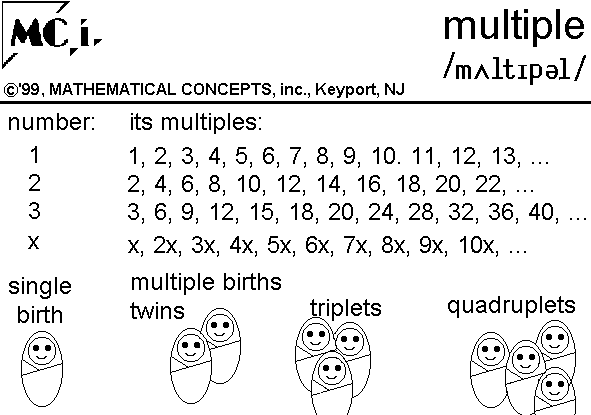
multiples of a number
References / Resources
Operations
multiply
divide
take a square root
Manipulatives
digital
big paper
smaller paper


Vocabulary

    There are 3 kinds of Napier's rods or bones or strips.

  • Digit bones.
          More than one digit bone of the same kind is needed to represent a number with more than one of the same digit, 11 and 3345, for example.
     
  • Index bone.
          It's used to help align the strips and to identify rows on the digit strips.
     
  • Square root bone.
          Because taking a root requires 3 simultaneous computations, 3 column are needed on the bone. These are the square of the digit, the double of the digit, and the digit.


Multiples


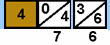
      Each bone depicts the multiples of the one-digit number at the top of the bone. See the 7 bone above.

      Multiples are used here to complete multiplication, division, or taking a root.


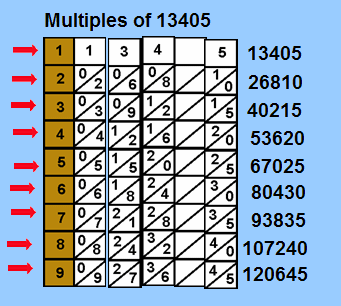
To obtain multiples of a multi-digit number:
1st: Arrange bones for the multi-digit number to the right of the index bone.
2nd: Recognize each row represents a multiple of that number -- the product of the number and the index number.
3rd: Write the sum of the digits in each diagonal of the row, one digit per diagonal.   Carry as needed. This sum is the product, a multiple of the number.


Operations
 
Multiplication
 
Multiply a (1-digit number)(multi-digit number)

1st:Arrange bones for the multi-digit number to the right of the index bone.
2nd:Identify the row representing the 1-digit number.
3rd: Write the sum of the digits in each diagonal of the row, one digit per diagonal.   Carry as needed. This is the product.


Multiply

Multiply Any Numbers
1st:Think pencil & paper multiplication. The rows on the bones provide the rows of the multiplication problem.
2nd:Arrange bones for one number to the right of the index bone.
3rd:Identify a row for each digit of the multiplier.
    Write the sum of the digits in each diagonal in the row, one digit per diagonal.   Carry as needed. This is the product of the 1-digit number by the multi-digit number.
4th:Lay out the problem as in a pencil and paper multiplication.
    Let each row product serve as the corresponding row of the multiplication.
    Remember to shift, indent, to the left to line up the correct place.
5th:The sum of the shifted rows is the final product.
Click on graphic to enlarge.


Division
 
Divide Two Numbers:
1st:Napier's bones will do the multiplication and division steps using multiples. The user does the subtraction steps.
2nd:Use the bones to create multiples of the divisor.
3rd:Use the largest multiple equal to or smaller than the left-most part of the dividend, the number to be divided.
4th:Divide. Multiply. Subtract. Bring Down as usual.


About the Square Root
 
Take a Square Root

    There is an additional Napier's bone for completeing this computation -- the square root bone.

    The Napier's bones do all the hard work -- you just fill in the pieces and complete the subtractions.

    The square root bone has columns for the square of a digit, double the digit, and the digit.

    The impact of the square of a digit, the double of the digit, and the digit is illustrated in the algebra and figure below.

  • The sum of the first square (x2),
  • the product of the double of the number which produced the square and the number which produces the second square (2xy),
  • and the second square (y2),
  • is
  • the square of the sums of the two numbers (x + y)2.


The Square Root Algorithm

1st:Recall the columns on the square root bone are, from left to right, the square of the digit, the double of the digit, and the digit.
The square will be used to:
  • identify the next digit of the root,
  • decrease the radicand making a new "radicand remainer," and to
  • act as a bone in creating multiples as is done in multiplication and division.
The double will be used to:
  • identify the first bones used on the board to create multiples, and then to
  • modify the set of bones on the board used to make multiples and take the root.
The digit will be used to:
  • identify the row of bones and to
  • become the next digit of the root.
2nd:From the decimal, to the left with whole numbers and also to the right with decimal numbers, group digits of the radicand in pairs.
3rd:Begin with the left-most pair (or single digit should there be an odd number of whole number digits).
4th:On the square root bone, find the largest square smaller than or equal to this pair.
5th:Write it below the left-most radicand pair and subtract to produce a "radicand remainder."
6th:On the square root bone, on the same row, find the digit and record it to the far left of the radicand as first or next digit of the radicand.
7th:On the square root bone, on the same row, find the double of the digit and place bone(s) for this number on the board. Should the process be repeated use the following rule. If the double has one digit,
  • make the units digit of the double the new last digit of the root.
If the doube has two digits,
  • make the units digit of the double the new last digit of the root.
  • Take the existing number represented by bones on the board, add to it the tens digit of the double and place bones on the board.
8th:Use both the "radicand remainder," from step 5, and the next pair to create the next "new radicand."
9th:Repeat the procedure until the desired accuracy is achieved or until the "radicand remainer" is 0.


Click on graphic to enlarge.
4th, 5th, 6th steps
first part of 7th step
second part of 7th step, 8th
9th: "radicand remainder" is 0


Click on graphic to enlarge.
For each digit of the root, find the square, take the digit for the root, use the double to choose bones for the next repetition.
References / Resources Resources
Azzolino, Agnes "algorithm"
© 2005 at www.mathnstuff.com/math/spoken/here/1words/a/a11.htm
(last modified 2005), visited 10 April 2009.
Azzolino, Agnes "Multiplication & Division"
© 2008 at www.mathnstuff.com/math/algebra/tt15.htm#divide
visited 10 April 2009.
Azzolino, Agnes "multiple"
© 2005 at www.mathnstuff.com/math/spoken/here/1words/m/m29.htm
visited 10 April 2009.
Wikipedia®', Wikimedia Foundation, Inc., "Napier's bones - From Wikipedia, the free encyclopedia"
GNU Free Documentation License at http://en.wikipedia.org/wiki/Napier%27s_bones
(last modified 16 March 2009, at 20:42 (UTC) ), visited 10 April 2009.
 
Manipulatives
Azzolino, Agnes"napierb.xls - Digital Manipulative Spread Sheet"
© 2009 at www.mathnstuff.com/math/spoken/here/2class/60/napierb.xls
Azzolino, Agnes"nbonesD.gif - Big graphic for paper version of Napier's Bones"
© 2009 at www.mathnstuff.com/math/spoken/here/2class/60/nbonesD.gif
Azzolino, Agnes"nbonesE.gif - Small graphic for paper version of Napier's Bones"
© 2009 at www.mathnstuff.com/math/spoken/here/2class/60/napierb.xls

[MC,i. Home] [Table] [Words] Classes [this semester's schedule w/links] [Good Stuff -- free & valuable resources]
© 2009, Agnes Azzolino
www.mathnstuff.com/math/spoken/here/2class/60/nbones.htm