Function and Relation Library
- Trigonometric Functions:
Angle Definitions
Legs of A Triangle Definitions
- Sine Cosine
Tangent Secant
Cosecant Cotangent
Trig functions are functions of a number, y = f(x) and very often that number is an angle, y = f(x) or y = f(
 ).
).
 |
 Visit the Interactive Sketch Pad Material
On Trig Functions |
-
sinplay -- just right triangle sine
-
cosplay -- just right triangle cosine
-
tanplay -- just right triangle tangent
-
TraceSin -- drag point f(x) to state and show new ( x, f(x))
-
TraceCos -- drag point f(x) to state and show new ( x, f(x))
-
TraceTan -- just graph with a slideable point to display coordinates
-
SinCosTan1stDay -- Just sine, cosine, tangent of right triangle angles.
-
SinCosTan6fx -- All 6 functions in right triangle only.
-
SinCosTanAllNumbers -- All 6 functions in right triangle and forall numbers,
* controlled by figure for right triangle,
* parameter-defined angle measure in degrees for all measures, and
* parameter-defined angle measure in decimal number times pi for radian measures
-
sinNcos.gsp -- sine and cosine in right triangle only
-
2 Sine Functions -- Asin(Bx-C) + D on 2 functions for comparison also h(x) = sine + cosine
-
SinTraceDerSums -- Sine from many views, right triangle, ABCD, derivative, antiderivative
|
|
|
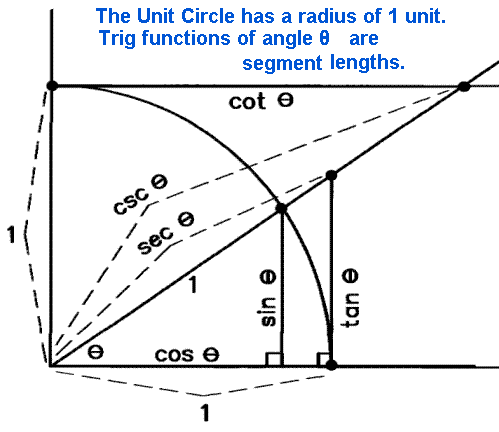
As the point on the circle changes, the angle changes, since the point is on the
terminal side of the angle. As the angle changes, the length of each of the segments it
determine changes. As the length of the segment changes, the trig function changes.
Open the page in the box above to see this work! With a radius of 1:
- The sine, is the length of AE.
- The cosine is the length of BE.
- The tangent is the length of FC.
- The cosecant is the length of BG.
- The secant is the length of BF.
- The cotangent is the length of DG.
For a radius other than one, the ratios below must be used to scale up or down the
size of the circle and yield the value of the function.
For more on this read
The Unit Circle. |
 |
Functions may also be defined in terms of x and y and r of right triangle ABE.
The horizontal segment BE is leg x.
The vertical segment AE is leg y.
The segment AB is side r and the hypotenuse of the right triangle and is still the
radius of the circle on which point (x,y) lies, and still the distance from the point to the origin.
Defined in terms of x and y and r -- the lengths of BE, AE, and AB -- the sides of
right triangle ABE, here are the trig functions.
- The sine is the ratio AE/AB.
- The cosine is the ratio BE/AB.
- The tangent is the ratio AE/BE.
- The cosecant is the ratio AB/AE.
- The secant is the ratio AB/BE.
- The cotangent is the ratio BE/AE.
For info on each function, read below. |
THE SINE FUNCTION
- y = sin (x)
- opposite function: y = - sin(x)
- reciprocal function: y = csc (x), the cosecant
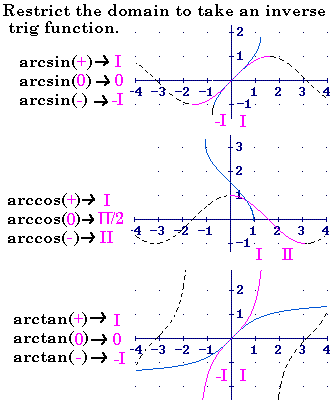
- inverse function: y = arcsin (x), the
arcsine
- slope function: y = cos(x), the cosine
- period: 2
 or 360°
 - range: -1 < y < 1
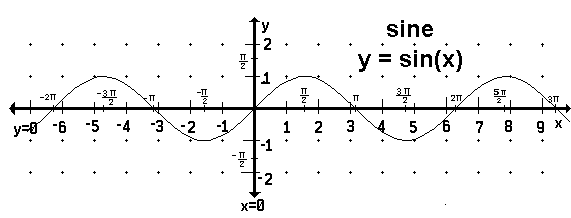
The sine is the ratio of the y to r, the ratio of the vertical component to the radius.
The sine is useful for describing natural phenomena and for writing Fourier series to
describe relations.
The sine of x may be computed to desired accuracy using
sin x = x - x3/3! + x5/5! - x7/7! + ...
THE COSINE FUNCTION
- y = cos(x)
- opposite function:y = - cos(x)
- reciprocal function: y = sec(x), the secant
- inverse function: y = arccos(x), the
arccosine
- slope function: y = - sin(x)
- period: 2
or 360°
- range: -1 < y < 1

The cosine, cos x, is the ratio of x to r, the ratio of the horizontal component to the radius.
It is useful in describing natural phenomena particularly in writing Fourier series
for relations.
The cosine of a number, cos(x), may be evaluated to desired accuracy using
the expression cos(x) = 1 - x2/2! + x4/4! - x6/6! + ...
THE COSECANT FUNCTION
- y = csc(x)
- infinite or undefined: when x is 0 ± k(
/2) where k= 1, 2, 3, ..., whenever the sine is 0
- opposite function: y = - csc(x)
- reciprocal function: y = sin(x), the sine
- inverse function: y= arccsc(x), the arccosecant
- slope function:y = -csc(x) · cot(x), the opposite of the product of the cosecant and cotangent.
- period: 2
or 360°
- range: -
 to -1 and also + 1 to +
, the range does not include numbers between -1 and +1
to -1 and also + 1 to +
, the range does not include numbers between -1 and +1
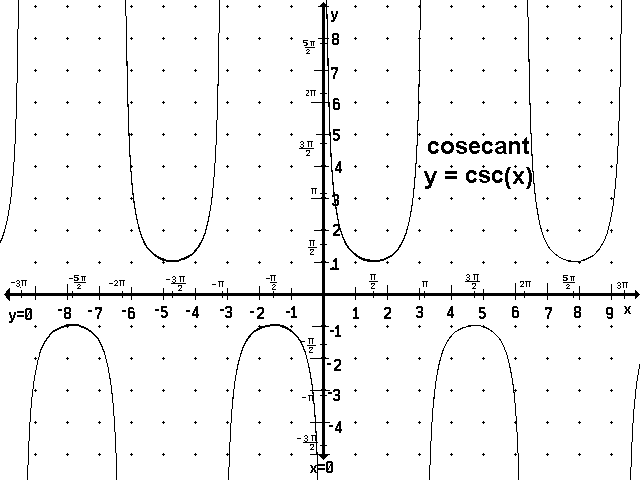
The cosecant, csc x, is the ratio of r to x. It is the reciprocal of the sine.
Because it is the reciprocal of the sine, when the sine increases the cosecant decreases. When the sine reaches a maximum, the cosecant reaches a minimum.
When the sine is 0, the cosecant is undefined or infinite in size.
THE SECANT FUNCTION - y = sec(x)
- infinite or undefined: when x is ± k(
/2) where k= 1, 2, 3, ..., whenever the cosine is 0
- opposite function: y = - sec(x)
- reciprocal function: y = cos(x), the cosine
- inverse function: y = arcsec(x), the arcsecant
- slope function: y = sec(x) · tan(x), the product of the secant and tangent.
- period: 2
or 360°
- range: -
to -1 and also + 1 to
, the range does not include numbers between -1 and +1
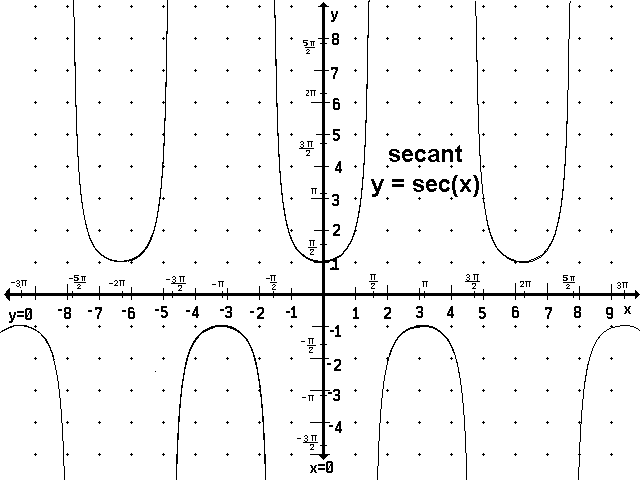
The secant, sec x, is the reciprocal of the cosine, the ratio of r to x.
When the cosine is 0, the secant is undefined. When the cosine reaches a relative
maximum, the secant is at a relative minimum.
THE TANGENT FUNCTION - y = tan(x)
- infinite or undefined: when x is 0 ± k(
) where k= 1, 2, 3, ...
- opposite function: y = - tan(x)
- reciprocal function: y = cot(x), the cotangent
- inverse function: y = arctan(x), the arctangent
- slope function: y = sec²(x), the square of the secant
- period:
or 180°
- range: -
to +
, all numbers are in the range

The tangent is the ratio of y to x, the ratio of the sine to the cosine:
tan(x) = sin(x)/cos(x).
The tangent is very useful in trigonometry.
THE COTANGENT FUNCTION - y = cot(x)
- undefined: when x is ± k(
/2) where k= 1, 2, 3, ..., whenever the tangent is 0
- opposite function: y = - cot(x)
- reciprocal function: y = tan(x), the tangent
- inverse function: y= arccot(x), the arccotangent
- slope function: y = - csc²(x)
- period:
or 180°
- range: -
to +
, all numbers are in the range
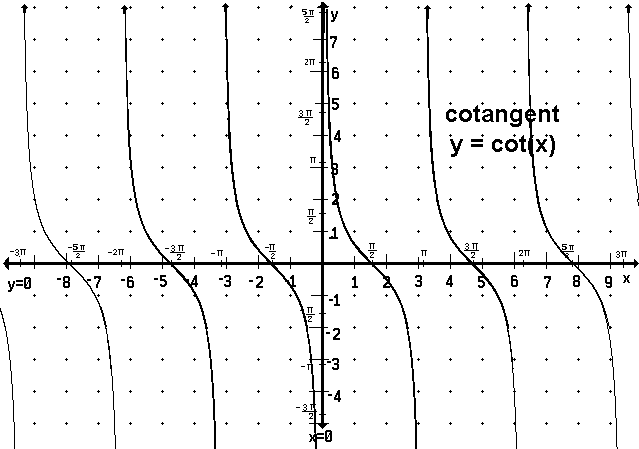
The cotangent is the reciprocal of the tangent. It is the ratio of x to y. It is also the
ratio of the cosine to the sine: cot(x) = cos(x)/sin(x).
This page is from Exploring Functions Throught
the Use of Manipulatives (ISBN: 0-9623593-3-5).
You are hereby granted permission to make ONE printed copy of this page
and its picture(s) for your PERSONAL and not-for-profit use. YOU MAY NOT MAKE
ANY ADDITIONAL COPIES OF THIS PAGE, ITS PICTURE(S), ITS SOUND CLIP(S), OR ITS ANIMATED
GIFS WITHOUT PERMISSION.
 |
![[MC,i. Home]](//www.mathnstuff.com/math/spoken/here/1gif/mcihome.gif)
![[Table]](//www.mathnstuff.com/math/spoken/here/1gif/table.gif)
![[Words]](//www.mathnstuff.com/math/spoken/here/1gif/words.gif)

![[this semester's schedule w/links]](//www.mathnstuff.com/gif/semestr.gif)
![[Good Stuff -- free & valuable resources]](//www.mathnstuff.com/gif/goods.gif)
![[next]](//www.mathnstuff.com/math/spoken/here/1gif/next.gif)
![[last]](//www.mathnstuff.com/math/spoken/here/1gif/last.gif)
© 2006, 2018, 2019, Agnes Azzolino
www.mathnstuff.com/math/spoken/here/2class/300/fx/library/trigfx.htm
|

 ).
).
 or 360°
  to -1 and also + 1 to +

![[MC,i. Home]](http://www.mathnstuff.com/math/spoken/here/1gif/mcihome.gif)
![[Table]](http://www.mathnstuff.com/math/spoken/here/1gif/table.gif)
![[Words]](http://www.mathnstuff.com/math/spoken/here/1gif/words.gif)

![[this semester's schedule w/links]](http://www.mathnstuff.com/gif/semestr.gif)
![[Good Stuff -- free & valuable resources]](http://www.mathnstuff.com/gif/goods.gif)
![[next]](http://www.mathnstuff.com/math/spoken/here/1gif/next.gif)
![[last]](http://www.mathnstuff.com/math/spoken/here/1gif/last.gif)